"ONLY CONNECT"

Look, the President of the United States is accused—credibly—of raping children. What shall we do about that? And what shall we do about the fact that the gangster leaders of most of the world’s nations are caught up in it, too, either via Epstein’s island or via the financial corruption and money-laundering associated with the trafficking of children for sex?
I have been arguing for nearly 30 years now that the sexual exploitation of children is the essential manifestation of might-makes-right, of a power dynamic that in various guises tyrannizes the world. Swimming against the tide of minimization, I have been reluctant at times to engage with people who need desperately to believe this is not how the world works, who need to believe in benign leadership.
I was called a fanatic. Whenever I wrote about child sexual abuse, I’d get phone calls screaming at me that I was wearing a tinfoil hat, or wondering why I didn’t write about “more important things” and suggesting that I was unconscionably projecting my unfortunate and rare experience onto others and creating “hysteria.”
This was before the exposure of the world’s largest pedophile ring, operating within the Roman Catholic Church, and before a similar scandal at Boy Scouts of America. I’ve yet to hear an apology or even an admission of error from any of the people who accused me of creating a “moral panic.”
As E. M. Forster suggested: “Only connect.” The cruelty of our American Fascists is connected to the cruelty of child sexual abuse. The cruelty of child rape is connected to the murders of Renee Good and Alex Pretti and those who have died in ICE custody.
Please, don’t anyone come at me with the tired “witch hunt” trope or the accusation that I’m spreading panic. This is the moment to wake up and connect the dots. We need a new world, one not run like a combination brothel and plantation. Let’s get started.
Mike Nellis, from his Substack “Endless Urgency”: “decades of silence, cover-up, and delay—while survivors are dragged back through their trauma by a system designed to exhaust them into silence.
I have been trying for all that time — and, yes, it is exhausting — to delineate and describe that system. I was first given that opportunity when my memoir Half the House was about to go into paperback. The pedophile I’d named as my rapist had just been arrested (later he would be murdered in prison) and I was asked to write an “Afterword” to the new edition. I wrote a long essay my editor kept wanting to cut. She said they just wanted a brief response to the arrest. I couldn’t do that.
Some time later, I was invited by the late novelist Tom Kennedy, an American ex-pat living in Copenhagen, to contribute an essay to a themed issue of The Literary Review, “The Secret Life of the Writer,” and I took the opportunity to once again try to make sense of my childhood violation, this time through the lens of a diseased masculinity that celebrates militarism.
I wrote those two essays (and subsequent ones in Remembering the Alchemists) because watching the same protective moves by media to isolate each instance of child abuse, to make it a psychological or medical problem to be solved by treatments for both perps and victims, to warn against hysteria, to protect respectable people from innuendo, etc. etc., I felt always the same gut hollowing response, the same fog descending, the same despair. It was give in or try again to once and for all break through the mis- and disinformation that surrounded this crime.
And so, I am posting both those “afterwords” here because they represent my thinking about the real nature of childhood abuse. I hope people will find that thinking useful to their own.
Half the House: a Memoir
Afterword to the Harvest edition, 1996
“Memory is not only a victory over time, it is also a triumph over injustice.”—Elie Wiesel
I chose to begin Half the House, not with the usual disclaimer one finds in the front of novels, but with what might be called a reclaimer, since it is the purpose of the book to reclaim all manner of lost things. It spells out the kind of not-fiction it is and sets forth the rules I followed.
This is not a work of fiction. It contains no composite characters, no invented scenes. I have, in most instances, altered the names of persons outside my family. In one instance, on principle, I have not.
In other words, I drew the people in the book as I remembered them. I conducted no interviews. I did no research. I was telling a story I knew by heart.
And yet I did not always know it well enough to tell it truly.
When I was a boy, there was a time from about July to the middle of September when the water in the Jordan Creek was so clear you could see down several feet to the bottom. Especially when the sun had sunk low behind the trees, and there was no glare, you could lean over the bridge and look down and watch the trout and suckers and carp and sunfish until it got dark. If you spit—och-tooey!—a sunny or sometimes even a trout would rise to the surface to investigate.
Half the House was written over many years during similar brief seasons of clarity. Other times memory seemed frozen and impenetrable. There were also periods of torrential grief, which roiled the waters and changed where everything belonged, followed a while later by new understandings.
Some of the events in the book were written about many years after they happened and years before they found their right place in the story. Other events were recounted only a year or two after they occurred.
And of course, during all this time, there was a life to be led. And dying I had to stop doing. There was a marriage trying to survive “the booze and everything.” And after a time there were my children, who needed more than a ghost-boy for a father, a wanderer of graveyards and old ball fields, a solitary fisherman seeking peace and calm.
There are “no invented scenes” in Half the House because none were necessary. For surreality, for downright weirdness, fact wins, hands down, every time. For example, on the very spot where Feifel first put a hook in my ice-cream cone, so to speak, and pulled me “right up out of [my] life, boom, just like that,” there is now a triple-X video parlor. When I saw it, the hair went up on the back of my neck. I discovered this while I was still writing the book, too, but it was so exactly right that it would have seemed like fiction, and bad fiction at that. I had been working long and hard to fashion the world of the past into a text that would not only reflect that world, but do so on art’s terms, with meaning carried in its correspondences and juxtapositions, its connections, its rhymes. And here was the world itself doing exactly that, it seemed, with no help from me! It was like a darker version of one of those children’s stories in which, waking from a dream and rubbing his eyes in disappointment that the soaring eagle was a phantasm, the child discovers a feather floating down, alighting on the bedclothes.
It is easy, in retrospect, to see this as an omen, or as a message from the world, saying something like what Faulkner said, “The past is not dead. The past isn’t even past.” At the time, however, I just scratched my tingling scalp and drove on.
Then, on November 5, 1995, my father telephoned.
“The son of a bitch is back,” was all he said at first.
“What do you mean?”
“Feifel. The god-damned snake. He’s back. Coaching.”
“Where?”
“Right here in Allentown! It don’t look like he ever really stopped. They’re going to pick him up tomorrow. They’ve got new charges on him, new kids, ten, eleven years old. Some of the mothers got hold of your book. They’re going to nail the son of a bitch this time.”
“This is unbelievable.”
“It’s true. Talk to your brother Joe sometime. He was in a bookstore the other day and some woman come in and walked right up to the cashier, no browsing around or nothing, and asked the guy for your book. Joe says she was whispering and looking around to see if anyone was watching, and she stuck it in her purse like it was pornography or something and ran right out. When he told me, I says, ‘I’ll bet that was one of the mothers.’ Anyway, I talked to a buddy of mine who says they got a warrant. They’re going to slap the cuffs on him tomorrow or the next day.”
What I didn’t know yet, because he hadn’t told me, was that my father was the one who had put the book in the hands of a friend of his who headed the youth organization where it turned out that Feifel was coaching. My father’s friend had spoken to the mothers of several boys who were often seen with him. One of them, it was true, was the woman my brother saw in the bookstore. But it was, in fact, my father who had set events in motion.
When I learned this, a few days later, I thanked him.
“I couldn’t help it,” he said to me on the phone. “I thought about these kids here. And I thought . . . I thought, what if you hadn’t moved away? If you’d stayed in Allentown, then maybe Robert would have been on that team, and I thought, hell, does this snake get a crack at the next generation too?”
I was crying by then, leaning on the counter in the kitchen of the house he’d helped me buy.
“Man, I feel great!” my father was saying. “I feel fifty years younger!”
It was the decision, on principle, not to change the name Tom Feifel that proved to be fateful. There was simply no reason to protect him. I did not foresee anything like what happened. I had no incendiary intentions. I pictured him, if indeed he was still alive, as old and pathetic, living alone, surrounded by stacks of porn magazines.
I thought, more often, of some of my old teammates, none of whom I’d seen in decades. If Feifel fit the statistical profile, he had had hundreds of victims, and in fact I believe I know, thinking back, who many of them were. There was, I feel certain, the boy I called Scooter in the book, but there were many, many others as well.
The day after the arrest, my brother Joe faxed the news article about it to my office. Below the headline, Feifel’s photograph is next to mine, our framed faces side by side. When I saw his face, after more than thirty-five years, I started shaking, overcome by a wave of anger and revulsion.
My photo is the one a friend took for the jacket of my book; Feifel’s has lines behind his head that look as if he’s standing before a venetian blind. Of course, I suddenly understood, this is his lineup photo! The symmetry of those two faces seemed, for the moment, nothing less than the restoration of moral order in the world, the pans of the scales of justice balanced at last.
But in the midst of this giddy sensation that some miraculous event had occurred, something else was emerging. A disturbing question. How could this man have ravaged the childhoods of so many, hundreds it seemed, over a period that now appeared to span more than forty years?
When the story went out on the Associated Press wire, the police began receiving calls, from all over the country, from men in their forties, thirties, twenties, and of course from the parents of young boys who had recently been violated by Feifel. The numbers climbed. “We’re at the tip of the iceberg with this,” said Gerry Procanyn, the detective who arrested Feifel. “Those who have seen articles or who have purchased the book are calling to let us know that this is not something that happened just six months ago, that they were victims years ago. We’ve had calls from as far away as Florida.”
Procanyn had been involved with both of Feifel’s previous arrests. The first took place in 1967, the year I graduated from high school. (In Half the House, I recount a conversation with my father in which he told me that Feifel was arrested in 1970. That information is incorrect, but it is not the date that matters in any case.) The charge was sodomy. The mother of the boy Feifel raped, however, chose not to put her child through the further trauma of a trial. The charge was reduced to disorderly conduct.
In 1984, during my mother’s final illness, Feifel went before a judge again, this time on charges of “involuntary deviate sexual intercourse and corruption of a minor.” He pleaded guilty to the lesser charge in return for a sentence of eighteen months’ probation. He also agreed to seek counseling for his “problem.”
It is hard to use the word evil these days without incurring suspicion. It is as if we cannot believe anything with our whole hearts, and we devise ever more sophisticated-sounding ways to refrain from certainty and the action it will require. At what point does a healthy skepticism become moral incapacity? At what point is our professed confusion really cowardice? To use the word evil, outside a philosophical or literary discussion of “the problem of evil,” is to risk being called a religionist or a right-wing reactionary.
For those of us who are neither, the discomfort arises from the mistaken conclusion that since there is no longer a single religious meaning we hold in common, then there are also no reliable meanings to be read in our histories, whether as individuals or communities.
Words are how we “come to terms” with experience. If the terms we use do not reflect reality, but hide and distort it, then our discourse, the community’s ongoing conversation about itself, will be corrupted.
Within a day or two of Feifel’s arrest, his attorney described him to the press as “a sixty-eight-year-old man with diabetes and a heart condition. He’s also got another medical condition, I guess, called pedophilia.”
When I read that statement, I was relieved. His lawyer was not protesting Feifel’s innocence. At the same time, with the enormity of Feifel’s devastation becoming clearer daily, I was moved to suggest to my brother Joe that Jeffrey Dahmer must have had a “medical condition, I guess.” It’s called cannibalism.
The word pedophile comes from Greek and means, literally, “one who loves children.” What an Orwellian inversion.
The rape of a child is an act of violence and an expression of contempt, not of sexuality or affection. The term pedophile is more than a misnomer, however; a clinical—that is, pseudomedical—term, it asks us to see such evil as arising from disease or illness, evil in its effect, perhaps, but no more intentional than, say, muscular dystrophy. This makes the violation of children a part of the natural order and the perpetrator one who cannot help himself. On one of the few occasions when he spoke to a reporter, Feifel said, “They tell me it can’t be controlled.”
It may be hard, in our historical moment, to distinguish between misfortune and evil. Perhaps our century’s man-made horrors, including the fear of all life’s annihilation in a blast detonated by a human hand, has made the point seem moot.
It is not. To view avoidable suffering, caused by monstrous selfishness and an utter absence of empathy, as mere misfortune or a “medical condition,” is to blame the gods and kick the victims to the curb. It is a betrayal of the very idea of the human and the ultimate capitulation to fatalism and despair.
At the same time, implicit in the view that people are responsible for their actions is the idea, which I, for one, cannot live without, that transformation is possible, that people can change. We are none of us merely good or evil, but our deeds are.
In place of the term pedophile, then, let me offer an alternative: pedoscele, from the Latin scelus, meaning “evil deed.” Try it. Pedoscele: one who does evil to children.
If this kind of criminal is a genetic anomaly, or psychologically malformed (when in doubt, blame his mother), then the community itself bears no responsibility, either to examine the social, political, and cultural forces that continue to give rise to such evil or to mete out justice, since the evil is, after all, a “medical” problem.
But if we understand Feifel’s “disease,” for the moment, as the analogy that it is rather than as literal truth, then its “cure” lies not in gene splicing, new drugs, or even new understandings of abnormal psychology, but in changing the way that the culture views children, especially the systems of cruelty designed to turn boys into gladiators with nothing but contempt for weakness, which is in turn absurdly and derisively identified with all things female. Because the curriculum of cruelty, with its emphasis on obedience to authority, alienation from emotion, desensitization to pain, destruction of empathy, and worship of victory still prevails in the raising of boys, there will be more victims and more pedosceles, more Feifels.
I believe that the silence that allowed Feifel to extinguish the joy of so many is not a static but a dynamic silence. It required participation. Many knew. Fear, shame, cowardice, ignorance—all these things played a part. Some thought it merely “naughty.” I have heard the word diddle used to describe (and dismiss) the violation of children, as in “He likes to diddle little boys.” It is a word that seems made to order, silly sounding, sniggering. Playing around, fooling around, fucking around—great foggy euphemisms into which real children vanish.
Feifel behaved as if there were no such thing as justice, and the community, for nearly forty years, gave him no reason to believe otherwise. The silence that allowed him to violate what now appears to have been hundreds of children must be examined. If we describe it accurately, its roles and processes, its parts and mechanisms, it can serve as a template for understanding how the same silence works in other communities. Then we can begin to dismantle the structure of shame, lies, and fear that renders us blind to the suffering of so many children.
Half the house will have to come down.
Soon my phone was ringing daily with calls from men across the country who were looking for help coming to terms with their own histories. Typically such calls would begin, “Hello? I’m not sure I’ve got the right Richard Hoffman. Are you the guy who wrote a book called Half the House? I gotta talk to you, man. I’ve never been able to tell anybody this.”
The stories I heard then, outpourings of grief and rage, were almost more than I could bear. They told of camp counselors, priests, teachers, scoutmasters, coaches, uncles, fathers. Men with authority and power over children. And with continuing power, in the form of a paralyzing silence, over these men who were calling me now, who were finding speech after years, often decades, of mute suffering.
I kept a list of numbers next to the phone. Hot lines. Support groups. National organizations. After explaining that I was neither a therapist nor a law enforcement officer (often my first chance to speak came five or even ten minutes into the call), I listened. It was hardly necessary to say anything at all.
When you begin to speak, you disturb an inviolate wholeness, and you say what you can above the roar of forgetfulness, wearing you down with its insistence on the inconsequential nature of your memories, sweeping you down the long flume into exhaustion and defeat. I remember the first time I tried to tell someone.
He was a psychiatrist, the head of the mental health department of a large health maintenance organization. I had not been seeing him very long, maybe two or three weeks. I’d been referred to him to do “grief work” a few months after my mother died. “I think this is important,” I said. He said nothing, but made a note on his legal pad. My throat closed, and not only could I not get out the words, I could barely breathe. “Back,” I said. “When I was ten. There was this coach.”
When I finished telling the story, he slapped the pad and pen down on his desk and sneered at me. “Listen here, Tinker Bell,” he said, “enough of this. Either you decide that there was a little ass-fucking and cock-sucking back then and no big deal, or you can blow your brains out over it. So what’s it gonna be?”
What it was gonna be was four blocks to the nearest bar. I had already tried the first alternative, and it had carried me as far as it would. I had a child, a son named after my brother Bobby. Blow my brains out? Scotch. Double. No ice.
Sometimes it was obvious the caller had been drinking. Sometimes I suggested dealing with that first. I gave out numbers.
But I often wondered myself if they’d called the right Richard Hoffman. I had written Half the House as a literary work; as such, it arose from and embodied multiple intentions. I had intended to write about grief and family and history. I wrote about the time and place I was born into, the ongoing conversation of one American community and how a child tried to make sense of it. I wanted to subvert tired pieties, move readers to pity and outrage, remember and revivify the dead. Now newspaper headlines were calling it a “sex abuse memoir” and a “book about molestation.”
It seems to me that any work of personal history, in our Freud-shadowed age, is seen as a search for psychological relief. Applied to a literary work, this view tends to crowd out all others and becomes dismissive of more meaning than it makes. I suspect this is its function.
Soon after Half the House was published, and well before the arrest of Feifel, I was in a radio studio, about to be interviewed. As we prepared to begin, the interviewer told me that my book “must have been cathartic” for me. When I suggested that the term catharsis, before it was commandeered by psychology, was a literary term and that it stood for what the Greek dramatists tried to effect in their audience, not in themselves, I was told that I was full of it.
“Nonsense. Why else would you write such a book?” the interviewer said.
Flustered, I said that I wrote it because I am a writer and I had to. “Oh, give me a break,” she said. A technician adjusted my microphone, and while he fumbled with a length of cord, taping it to the table, I told her that Camus once said, in a radio interview, that we make art “to save from death a living image of our passions and our sufferings.” She was looking through a glass window at a technician using his fingers to count down from ten.
“So you think it’s art?”
“Yes. Or I would not have published it.”
“Well, I look forward to reading it.” We were on the air. “My guest is Richard Hoffman, who has just published a book about his life called Half the House. So, tell us, Richard Hoffman. What’s so special about your life that we should care enough about it to want to buy your book?”
“My book is not about my life,” I said. It was one of those rare moments when panic produces clarity. “My book is about our life.”
There is a simplistic notion, born of daytime television and pop psychology, that one tells the truth in order to unburden oneself, as if telling the truth could serve no other function. Not only is this wrong, but it perpetuates a cruel delusion, as if all one has to do is vomit up, undigested, the bilious and bitter truth, and, ah, that’s better. As if understanding how the past has shaped the present is of no importance. When people place their hope in such a mechanical view of their own humanity, they become fools on the road to despair. Telling the truth is an arduous process through which we accomplish not merely relief, but justice. The resistance to amnesia is a political commitment as well as a personal, literary, and spiritual one.
But all this talk of intention aside for a moment, what I learned from the stammering brave men who phoned me was something about the power of books and the inescapably political nature of art. I learned that our creations become creatures, living beings with agency and influence, the same way we ourselves accomplish this: by being born into the fallen world of time, of history.
A book is like a clock—a grandfather clock, maybe, handcrafted of oak with inlaid cherry and ash, brass pinecones, ship’s bells, maybe even a gilded cuckoo—that tells those who read it the time, and each who reads it knows what it is time, in his or her own day, to do.
No one, however, taught me more about the power of the written word than an eleven-year-old boy named Michael. He was one of four boys selected by the district attorney from among many more to testify against Feifel. Later on, at the pretrial hearing, they would tell of threats and pornography and all manner of violation, all of it sickeningly familiar to me. Michael had last been assaulted by Feifel less than a month before the arrest. His mother, the woman whom my brother Joe had noticed in the bookstore, phoned to ask if I would call her son some evening. “It would mean a lot to him,” she said.
It took me a few days to call. What could I say to him, a boy my son’s age, who might have been myself some thirty-five years earlier? What had I needed to hear? I felt I had nothing to give him. I called. His mother answered and went to get him.
“Hello?”
“Michael?”
“Yeah.”
“Michael, this is Richard Hoffman. I wanted to call you and see how you’re doing.”
“Yeah.”
“How are you?”
“Okay.”
This was going nowhere. “How are you doing in school? Is it hard right now with all this going on?”
“Nah.”
“Is it hard to concentrate on schoolwork?”
“Nah. I do good in school. I mean well.”
What did I have to say to him? “You’re a brave kid, Michael. Do you know that?”
“Yeah.”
I smiled and relaxed. This was familiar. I was talking to an eleven-year-old who was being talked to, or at, by a grown-up. “Well, that’s really all I wanted to tell you, that I think you’re a brave kid.”
“Yeah.”
“So hang in there, okay? I’ll give you a call again sometime, okay?”
“Yeah. Um. Thanks.”
“Sure,” I said. “No problem.”
“No. I mean thanks for, you know, for writing that book. You made it stop.”
It.
PICTURES OF BOYHOOD
Afterword to the New Rivers Press edition
Virtue consisted in winning; it consisted in being bigger, stronger, handsomer, richer, more popular, more elegant, more unscrupulous than other people—in dominating them, bullying them, making them suffer pain, making them look foolish, getting the better of them in every way. Life was hierarchical and whatever happened was right. There were the strong, who deserved to win and always did win, and there were the weak who deserved to lose and always did lose, everlastingly.
— George Orwell, Such, Such Were the Joys
I have tried to be done with this.
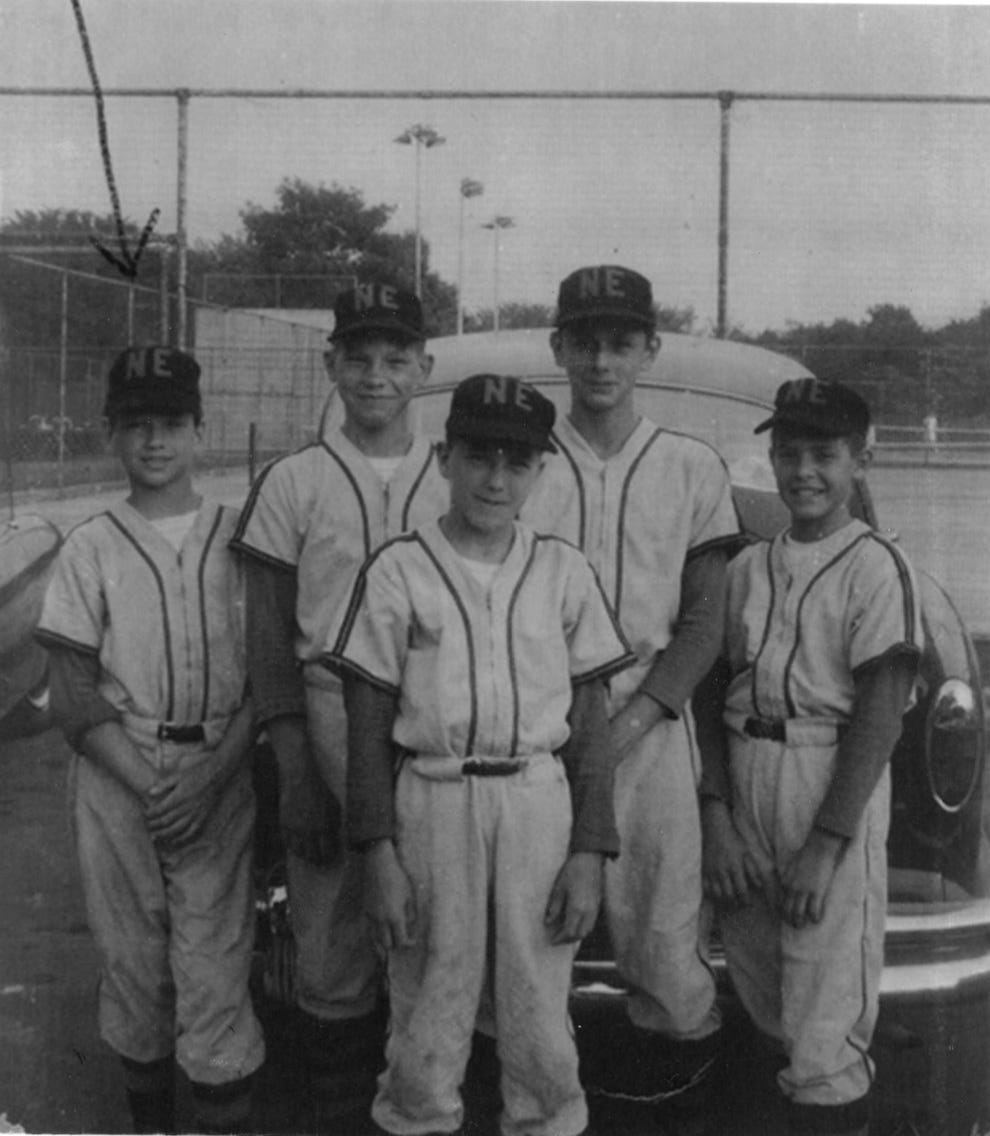
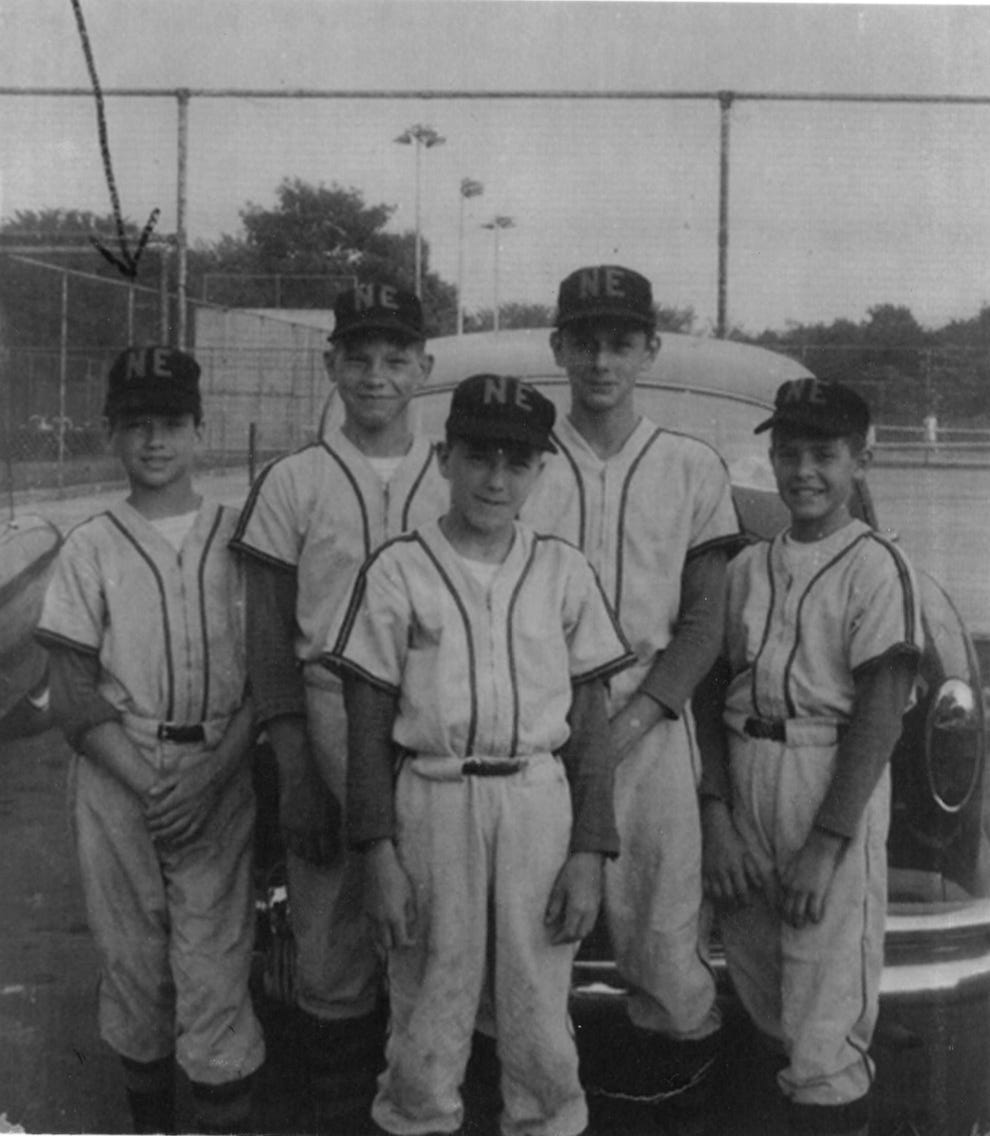
I am one of five boys in the picture. There is a ballpoint arrow coming down from the sky, from outside the frame of the photo, and it points to me. I don’t remember the names of two of the other four boys. We’re all in baseball uniforms. Although the photograph is black and white, I remember that our caps were black with orange letters — NE for North End — and that the trim on our uniforms was a thin black and orange brocade. I don’t remember this particular day although I know the spot where the photo was taken, just behind the handball courts at Jordan Park in Allentown, Pennsylvania. It is 1960 or 1961.
The coach of the North End team, Tom Feifel, the man who fixed us here, forever 12 or 13 years old, was arrested, convicted, and incarcerated largely as the result of the publication of my memoir, Half the House, published in 1995. He had been arrested twice before for sexually assaulting young boys but had never been sent to jail. This time, with a number of boys and their families determined to testify, and with corroborating phone calls from men in their 40’s, 30’s, 20’s whom he had also victimized as children, he agreed to a plea-bargain of 8 to 15 years in the state penitentiary. He was 68 at the time. It has been determined that he violated upwards of 400 boys during his nearly four decades of coaching.
On June 20, 1997 Dateline NBC aired an eighteen minute segment on Half the House and its impact. The program, shaped by Dateline correspondent John Hockenberry, was several weeks in the making and included lengthy interviews with me, with my father, and with a twelve year old boy named Michael, one of Feifel’s most recent victims. The segment was completed nearly a year before it finally aired, a year largely given over to the O. J. Simpson trial.
On the third day following the broadcast, I came home to a message from Detective Gerry Procanyn saying, simply, “I thought you should know that Mr. Feifel died yesterday morning after two days in the hospital.” In other words, he had been admitted to the prison hospital the morning after the Dateline broadcast. He was soon transferred to the local hospital, where he died.
I was immediately suspicious. I have worked as a volunteer in prison substance-abuse and violence prevention programs. There isn’t much to do in most prisons: lift weights, watch TV, and brutalize child rapists known as “skinners,” “short-eyes,” and a number of other terms.
I traveled to Pennsylvania to talk with Detective Procanyn who suggested we get together for breakfast. I thought I remembered where the diner was where we agreed to meet, but I left extra time in case I got lost. After all, more than thirty years had passed since I lived in that town. I got there early, of course. I sat in a booth where I could see the parking lot.
Gerry Procanyn was as I remembered him, short and stocky, sporting a trim VanDyke. He was wearing a suit and tie a little out of fashion and cowboy boots. As he approached the diner from his car, he ran a comb through his white hair and patted it on one side.
We ordered our breakfasts and Procanyn wanted to talk about “the TV show,” what he thought was good about it and what he wished they hadn’t left out. “I showed them all the evidence we had, all the stuff we collected from his house,” he said. “I think there’s a real story there. You heard anything else from those guys? Because when they were here a couple of them were talking about a movie. I think this would make a great movie. Nobody said nothing to you about that?”
I shook my head.
“You don’t hear from them at all anymore?”
I shook my head again.
He talked about his passion for restoring antique cars. Our food arrived. He asked about my dad whom he’d met at Feifel’s sentencing. He talked about his girlfriend, said he thought they might come to Boston one day and would it be okay to give me a call. Eventually I was able to ask him if he could find out how Feifel died.
“The death certificate from the Commonwealth of Pennsylvania says that the deceased Mr. Feifel suffered heart failure.” He was cutting a piece of ham; as he leaned forward and brought the fork to his mouth, he looked up as if to see if I’d noticed his change of tone.
“You don’t buy it,” I said.
His mouth was full. He shrugged, made a face. “That’s what it says.”
I poked at my homefries. I imagined Feifel watching the broadcast and understanding, really understanding, the nature of his crimes against children. Viewing his entire monstrous career compressed and focused in an eighteen minute account, I told myself, might have been too much for his heart, stripped of the denial that had allowed it to go on beating. I wanted his depravity and his death to be instructive. I wanted to conscript his disfigured spirit to squat eternally, a gothic grotesque shouldering one pillar of a better future. I wanted to believe in a justice not administered by men but by conscience itself. I wanted him dead from the force of unobstructed truth, not a victim of murder.
“Remember that Mr. Feifel has living relatives.” Gerry was holding his tomato juice in front of him as if he was about to make a toast.
“What do you mean?” It took me another moment before I understood what he meant: there was no way the state was going to invite a lawsuit from Feifel’s family.
He drank his juice. “Richard, my friend.” He wiped his lips on a napkin and leaned forward, gripping the table. “One day every person in this diner — you, me, everybody — will die of heart failure. Come on, finish up.” He raised his hand and looked for the waitress. “We’ll go up the station. I want to show you something.”
At the station I saw for the first time the evidence the police had assembled for Feifel’s trial. In addition to the pornography you’d expect, and the sex toys, (including a long, clear plastic tube I first thought was a bong, but was really a “penis pump”) there were the “adult” comic books I remembered: Popeye and Olive Oyl, Dagwood and Blondie, even Mickey and Minnie Mouse. There were pictures of women with animals, and women penetrated by guns. I was about to turn away, to tell Gerry I’d had enough. What was the point of this anyway? Then he directed my attention to a long narrow box. “Have a look in there,” he said. “I’ll bet you find that interesting.”
The box was filled with index cards. Each card had a picture of a young boy on it (unless the photo had fallen off), name, address, parents’ phone, height, weight, and on the back, a coded system of notations about what acts Feifel had committed on each boy — when, where — amounting to, I guess, a card-catalogue of masturbatory memories, or else a kind of trophy case. (Later, trying to tell my brother Joe about it, I said that maybe if Feifel could have had each of us stuffed and mounted, he would have. That was the feeling anyway.)
Thumbing through the cards, which were chronologically ordered, I started to recognize names. I was shaking by the time I came to my card. I wasn’t halfway through the box, not even close.
“What do you think?” Procanyn asked me.
I couldn’t speak. I squeezed his arm, turned, walked out, and drove back to my father’s house. Think? I have been thinking about that box for nearly five years now. It is the truth about child sexual abuse. In the face of talk about “man-boy love,” about “child-abuse hysteria,” about “witch-hunts,” about “false memories,” it is the truth. Inside it, in the darkness, are hundreds of boyhoods; inside it, in the silence, are hundreds of stories.
That is also how I came to have this photograph, printed for me by the police department’s photo lab. The copy has a greenish tint to it that I don’t remember from the original and is much larger. I don’t think I can say why I asked for a copy; that arrow started me to shaking when I first held the small snapshot in my hand. I knew I should have it; simple as that.
Wanting to be done with this story is a kind of denial. To “move on” seems, at least to me, to suggest that an entire chain of events, having come to some resolution, has now become inconsequential, as if the hard fruit of those branching consequences does not arrive over and over in its season. To hold that a return to silence now would not also have consequences is denial as well. In fact, I believe it would be a kind of suicide to so radically refuse the story of my life.
A journal entry from the month after publication of my memoir, well before Feifel’s arrest:
The danger for me, after Half the House, is to retreat in fear and stop remembering, to strike a pose toward the past that calcifies it, as if it has now been successfully packaged, boxed, wrapped, with no further pain nor wisdom for me. The danger is that I have sealed the well, or re-sealed it, put the lid back on it and walked away. It doesn’t matter when you seal the well, or even if you have ever unsealed it; when the well is sealed, you either begin your version of dying — a jerky choreography of compulsions and rationalizations — or you go off looking for someone else’s water to steal.
I have, in fact, moved on; what I have not done is try to move back, to a time before I understood the truth of my boyhood. Slowly and uncertainly, I am moving forward, trying to understand the ways in which my own boyhood is representative of many others’, how it was shaped by ideas and institutions that continue to enforce men’s estrangement first from one another, then from themselves, and finally from women and children. To the extent that “manhood” is a set of anxieties not congruent with the needs and concerns of women and children, to just such an extent is manhood dangerous, even death-dealing.
I learned this from the men in the prison where I ran a weekly substance-abuse group for two years. Working toward release to a half-way house, many of these men were at last ready to face their lives honestly. They had much at stake. Many of them had been violated as boys. They were at the time living in an environment in which the threat of sexual violence was very real. Yet, sitting around a table in a windowless, cinder-block room, they spoke of women in ways that objectified and demeaned them, turned them into prey. Unable to move beyond the wall of gender, unable to empathize, several said that to be sexually victimized would mean that the abuser had robbed them of their manhood; others nodded silently. The idea of “manhood” was so strong that they could not see that sexual violence is the most elemental violation of one’s humanity, regardless of one’s gender.
When I first agreed to lead this group, the program was designed as an 8-week course called “Tools of Recovery.” About the sixth week, after a great deal of grief expressed as anger, as blaming, as fantasized violence, one man, thundering and rising from his chair, suddenly became silent, sat, and head in his arms on the table, wept. As if it were a signal of some kind, a permission granted, a brave act that could only be honored by honesty, the men began to talk about boyhood.
With each new group of men, I lengthened the program, until the course ran for twelve weeks. I learned to wait. Usually the tears and the truth arrived together.
The other boys in the photo are my teammates but not my friends. Of the four of them, I remember the names of only the two taller boys. I’ll change them here and call them Kenny and Phil. It would not be improbable for either or both of them to have turned, immediately after this picture was taken, and thrown me to the ground right there on the asphalt parking lot, one or the other crying out, “Cherry belly!” while they sat on me and pulled out my shirtfront and smacked my stomach while I kicked and yelled until it was a mass of red welt. One or the other might finish by spitting down on my face, even saying, “What are you going to do about it?”
I have talked to many men who remember both getting and giving these “cherry bellies” and who seem to have accepted them as a normal feature of boyhood. That these assaults, which happened to me frequently, were a kind of rape is borne out by an incident a couple of years after this photo was taken, in 9th grade, on the bus to an “away” baseball game.
I had been subjected to the usual bullying, I suppose, because I can recall very clearly that my right arm hurt that day, my “pitching arm” I would have called it, though I was by no means one of our main pitchers; in fact, Kenny and Phil were our starters. I can see each of them on the mound. Nobody ever threw more overhand than Phil. His was a bizarre windmill of a delivery, more like a pitching machine than a baseball player. Kenny was what we called a “sidewinder”; he had a wicked fastball that cut across your body from left to right if you were a right-handed batter.
I can recall that painful knot between elbow and shoulder from their once again refreshed mark on me, kept black and blue and sore by knuckle punches there at every opportunity. To soothe the bruise by touching or rubbing it was the signal that would invite a fresh punch there.
Some time into the ride I discovered my glove was missing. Kenny and Phil were sitting two seats behind me, along the back bench of the bus.
“Hey, Hoffman. Where’s your glove?” No way I was going to turn around. There was a lot of laughter. “Should we give him his glove back?”
Kenny’s voice: “Can’t you see I’m not finished with it yet?”
“Me next! Me next!” More laughter.
After a while my glove came flying at me, smacking the side of my face. Something wet, viscous on my cheek. At first I thought they had all spit in it.
Now I see that I was targeted in a different way. After Feifel’s violation I seemed marked in some way that was visible to other boys. I’m reminded of that Far-Side cartoon of the two deer; one has a target of concentric circles on his chest, and the other says, “Bummer of a birthmark, Hal.” Boys do not walk up to other boys who are passive, cringing, and sad and ask what’s the matter. Not the boys in this picture; not the boys, adjacent strangers, with whom I passed my boyhood. I had a target on me.
The boys on the back of the bus knew that the adults riding up in front — our freshman baseball coach and the assistant principal, a priest — would have to disapprove if their behavior came to light. They also knew that their aggression was congruent with a set of manly virtues, martial virtues, really, that they had learned, chief among them the ability to nullify empathy. “How would you like it?” the outraged question asked by a woman — in our case most often a nun — asking us to take some lesson from our transgression, would be missing from the response of the aging warrior who was our high command, sitting up next to the driver, talking to the priest, his boss, and studiously not turning round. In fact, his ignorance was dependable. From time to time, if things got too loud, he would bellow, “Don’t make me have to come back there!” What would he have done had their cruelty and my ignominy been brought inescapably to his attention?
On the day this photo was taken, if Feifel had offered me a ride, I would have hesitated before saying no. I would have had to find another way to avoid Kenny and Phil, some way either to placate or elude them. Maybe this was the day, the day of this picture, when I was dragged to the creek and thrown in so that on my way home I had to make up a story about going deep for a fly ball in right field, running it down so intent on robbing the opposing batter of a home run, that I kept right on going, right over the retaining wall into the creek just as the ball smacked into the pocket of my glove. It seems I already understood how stories push against others’ expectations, desires, needs: what they want to hear; not to mention how they might be made to take the shape of what I want to be true.
I don’t know, can’t know, whether I am imagining or remembering the sting of my own sweat in the corners of my eyes, the invisible cloud of heat when the big round trunk of the car is opened and the musical clinking and clonking of hickory baseball bats as the canvas duffel is thrown in, the fine brown dust in my nostrils as the trunk is closed — whump.
The park where this picture was taken was the closest thing I ever experienced to paradise. These days I go there when I return to Pennsylvania to visit my father. We walk his dog there. I have written about this already, about the creek, about the white roaring rapids above the bridge at 7th street, the trout fanning in pools and eddies. Have I mentioned the benches along the creek, and the weeping willows’ long fronds trailing on the surface of the cloud-capturing water? The red and blue damselflies we called matchsticks? The cool darkness under the bridge, the lacework of trembling light on its walls? The way that the echo there taught me that silence is sound stretched thin by time?
But paradise is a myth made necessary by its loss. Paradise was simply the world, the real one. By the time this photograph was taken, however, I could only enjoy it alone, and after a while I even started to believe that my love for these sensual things was unmanly, that I was wrong to find pleasure in them. Certainly in the shrunken world of boyhood’s approved concerns there was no place for simple delight. Sneers were in ample supply.
All summer you could find Tom sitting in his car, a ‘51 Chevy, in the lot near the swimming pool, not far from where this picture was taken. The radio played — Come on, let’s twist again, like we did last summer — while Tom sat, left arm out the window, aviator sunglasses on, watching. Watching. I think now that down below the angle of our vision he was stroking himself, recalling encounters with some of us, fantasizing — and planning — encounters with others.
The boy in this picture, the boy I was, hands covering his crotch, seems to be asking “Why me?” Psychologists who study the behavior of men like Feifel suggest that the world of such a person is both obsessive and opportunistic. Far from simply stumbling into temptation, those who assault children generally position themselves where they will have continual access to them, and their crimes are the result of a single-minded calculus.
Our uniforms, the finest of any team in town, came complete with those baseball undershirts, white with colored sleeves, and major league style baseball socks with the high thin stirrup of the big leaguers, not those two-tone, low-down little league socks that the other teams wore and that looked like the kind of socks Ty Cobb or Roger Hornsby wore back in ancient times. Tom bought the uniforms, clothed us, with what he earned at his foreman’s job at the nearby shirt mill. He bought our bats, balls, catcher’s equipment. We were his team. We wore our hats with NE on them proudly, unaware that we had been bought, too. Every kid in town saw those uniforms and wanted to play for us. Parents, thankful that “somebody cares enough to do something for these kids” mistook Feifel’s reticence, his lack of eye contact, for modesty, or as embarassment at their expressions of gratitude, and this meant to them that “his heart’s in the right place,” that he wasn’t trying to make a reputation for himself, wasn’t asking for their votes, their business, their money. “He does it for the kids.” In our black and gold spiffy uniforms (“your baseball suit” my mother called it) we flacked for Feifel as surely as the other teams who had the names of banks and beer distributors and bowling alleys stitched across the back of their shirts. The man knew his business, even if nobody else did.
Anna Salter, in her landmark study, Transforming Trauma, quotes one predator as saying,
I guess it’s hard to, it’s really hard to say how you decide what child is appealing to you because, say, if you’ve got a group of 25 kids, you might find nine that are appealing, well, you’re not going to get all nine of them, but just by looking you’ve decided just from the looks what nine you want. Then you start looking at the family backgrounds. You find out all you can about them, and then you find out which ones are the most accessible, and eventually you get it down to the one that you think is the easiest target, and that’s who you do.1
There is no question about it. I am, in the photo, hardly there. My posture shrinks from the camera’s attention. I had contracted; somehow I no longer came all the way to my skin. I saw the world as if from deep within a cave. I was like a gangster who will sit only facing the door with his back to the wall. I mean this as a metaphysical position I’d assumed: call it mistrust, call it fear, call it alienation. I am hardly there. I had been emptied, gutted like a fish. I had forgotten myself. I had begun to assemble myself, piecemeal, as I would be thereafter, trying on this man’s scowl, that man’s walk.
As a boy, I loved the story of the child martyr Tarsisius. A Roman boy, he had been entrusted by the persecuted early Christian community to carry the consecrated Eucharist to a catacomb where, among the hidden faithful, the word made flesh would be consumed. On the way there, he was accosted by thugs who demanded to see what he was carrying under his cloak. “Next to his heart,” the nuns said. The bullies beat him savagely but he would not surrender the tiny incarnation of the divine that had been entrusted to him.
I was trying to be good. I was devout in my prayers, obsessive in my observance of the liturgy (gilded pages of exquisite thinness, purple grosgrain ribbon, every single day with its feasts and prayers and colors of the priest’s vestments and place in the seasons of the liturgical year) trying to be the best altar-boy at St. Francis of Assisi school. “What are ya, buckin’ for sainthood?” my father would say, a locution that makes me smile but also opens the doors of history to me, the world of my parents, the scarred consciousness of their generation with its critical mass of trauma survivors, raised in the Great Depression, sent off to the butchery of World War II, ready, on their return, to settle for any rung in the hierarchy except the bottom-most, any drug for the pain, any empty promise about the future.
I remember my ninth grade music teacher, a former bandleader in the Marines. One day when I was especially pleased with having mastered The Merry Widow Waltz on my trombone, he leaned into my face with his teeth gritted and a sneer curling his lip. “You think you’re some pretty bird. Oh you’re so smart! Oh you can do it all! You preen all day because you can sing. Because you think you can fly. Well let me tell you. Your song’s the same as any other: you sing for your supper. And you aren’t flying anywhere. You’re right here in the cage. With the rest of us. Get it?”
I learned nothing the year this photograph was taken, not even the things that mattered to me, like how to throw a curveball or how to pop a wheely on my bicycle or the Confiteor and Suscipe in Latin that would qualify me to serve at the altar even though I knew I was unworthy. Nothing would stay in my head. There was nothing wrong with my eyes, but the world was out of focus. I was the kid walking down the street staring into the middle distance, waking when a car-horn warned me to snap out of it. I’m lucky I didn’t get killed.
Worse, I could no longer play baseball. Oh, I could field all right, and throw; but at the plate I “stepped in the bucket,” down the third-base line instead of into the pitch. To some extent I think my debilitating fear was in response to a physical injury, although my constant state of distraction may have been the cause of it. I’d been beaned was the problem. I hadn’t been wearing a helmet and the ball hit me on the left cheek and I went down and then oh man it hurt. It hurt like hell even with an icepack on it. So after that, no matter how many fantasy homers I hit in my backyard, no matter how much excited commentary I supplied for my imaginary triumphs — And the crowd is on its feet! It’s going… going… gone! — I kept “stepping in the bucket,” down the third base line, afraid; “bailing out” we sometimes called it, and I struck out over and over again. I went from the starting line-up to the bench and stayed there. Finally, I quit and joined a rag-tag team without uniforms run by the Police Athletic League
Marty Romig was a cop, although I didn’t know anything about him in that respect. I seem to recall something about his having had a motorcycle accident on a slick road and that’s why he was no longer in uniform. Instead he ran — he was — the Police Athletic League, or PAL.
He spent Saturday mornings gathering us together from all over town, collecting bundles of old newspapers and rags in the process. It was a big, dark blue delivery truck with the PAL insignia on the side, a police badge with PAL inside it, the same badge sewn on the peaks of our caps. This ongoing paper-drive was how the program bought balls and bats and caps. I remember the stamped metal floor of the truck, and how we spent all morning wrestling one another on its waffled surface as the space shrank, filling with bundles of newspapers and magazines.
Marty was no baseball player. I remember him pitching batting practice with no form or grace to speak of, no oomph on the ball, and not much control either. Marty was a bowler. His right forearm looked like Popeye’s. That whole right forearm and hand were so hypertrophied that his left looked withered by comparison.
This was around the time that some kids were starting to throw a roundhouse curve, and it was humiliating when I ducked or stepped away from a ball that curved down and across the plate for a strike. I had had enough jeers. I was primed for self-hatred, and now I turned it on myself. I was a disgrace. I was a coward. I was a phony.
One day Marty asked me to stick around after practice. Just me. I remember I was bringing in second base. That was always the signal for the end of practice, when Marty would call out, “Okay, that’s it; bring in the bags!”
He squeezed my shoulder. “Don’t go anywhere. We’re going to try something, just you and me.”
I dropped the dusty base, picked it up, dropped my glove, bent to pick it up and tripped on the canvas strap hanging down from the base. My face was hot and dust was in my eyes.
“I can’t, coach. I have to get home.” My throat was tight as when I put my fingers down it to make myself throw up so my mother would let me skip school.
The next Saturday, he ended practice just as I was about to embarrass myself again at batting practice. “You stay,” he said.
When the other boys had gone, he took me by the elbow, walked me to home plate. “Tell you what,” he said. “Put the bat down a minute.” Then he drew a line with the toe of his shoe. (He didn’t wear baseball spikes, or even sneakers, just plain black oxfords and sagging trousers he stepped on at the heel.) “Now when I throw the ball, I want you to step down this line with your left foot. That’s all. Just step. Ready?”
He backed up only about 6 or 8 feet before he lobbed one past me. Underhand. Then another. And another. At first it was easy. I didn’t look at the ball. I looked down at my foot. After a while I looked at the ball and still managed to step along the line, toward the pitcher, not the third-baseman. Marty backed up a little each time. Every 15 or 20 pitches I gathered up the balls and threw them back to him.
“Okay,” he said. “Pick up your bat. Don’t swing though. Not till I say. Just keep stepping along that line.” The ball went by at nearly a normal speed. I stepped along the line. Again. Again. I wanted to swing so badly I could have screamed. Finally, he gave his permission.
“Crack!” I had forgotten how good it felt to hit the ball. Again, “Crack!”
I might easily have been left, if it were not for Marty, believing that adults all wanted something from me, no matter how they presented themselves, and that whatever I wanted or needed I was going to have to get for myself, without help, and probably at someone else’s expense. I don’t know anything about how he helped other kids though I believe he must have. What I know for sure was that he cared about a frightened eleven year old boy enough to help him overcome one fear that he knew about, and at least one other that he didn’t.
That Fall I showed up for football, of course. It was one thing to quit Tom’s baseball team, quite another to quit his Downtown Youth Center Bears, perennial champs of the 110-lb. league. To lack the “balls” to stick it out on Tom’s football team was a disgrace impossible to live down.
There was a drill most of us were unwilling to admit we dreaded called “bull-in-the-ring.” Twelve or fifteen players would form a tight circle and count off. Then Feifel would call out a number and that boy would jog into the center of the circle. Then he would bark out another number and that boy would charge and try to knock the boy in the center down. As soon as one charge was over, sometimes as the boy was still getting to his feet, Feifel would call out another number and let another “bull” into the ring. The boy in the center would have to whirl and be ready or he would get slammed, blindsided. You were there, in the ring, until Feifel decided you’d had enough. Often, after he’d administered the coup de grace by calling the number of a particularly ferocious favorite positioned directly behind the player struggling to his feet, he would step into the ring and help the boy up, taking off the kid’s helmet, grabbing him behind the neck and pulling him forehead to forehead with him. “Damn good job. Damn good. Ya all right? Good. Get your helmet back on.”
Disgrace loomed over us, always. One flinch or cringe and Feifel was likely to blow the whistle. “You’re done. You don’t wanna play. Turn in your uniform.”
“No, coach, please. Please, coach. Give me another chance!”
“All right then. Show me what you’re made of. Get back in there.”
On only one occasion do I recall a boy who decided for himself that he’d had enough. He staggered away with Feifel yelling after him, “You come back here now or don’t come back at all! You hear me?” The boy kept walking, weaving and wobbly, until he sat down under a tree near the parking lot, took off his helmet, and put his head in his hands, waiting there, an emblem of shame for the rest of us, for his father to come and pick him up. We never saw him again.
By the time I became a high school senior, I had remade myself, or at least constructed a new version of myself that hid the target. Looking back, the process seems no more complex than the ten or twelve panels that made up the cartoon ad for the Charles Atlas chest-expander on the back of nearly every comic book (on the inside back cover were mail order offers for telescopes, sea-monkeys, Chihuahuas, genuine rattlesnake rattles, jumping beans, and ant-farms.) The skinny guy with the rounded shoulders and concave chest is on a towel at the beach with a dazzling young woman in a two-piece bathing suit. The bully comes along and kicks sand in his face and unlike most of the women I have had the luck to know, the object of this poor scarecrow’s affections sneers at him and goes off on the arm of the grinning, armor-plated Neanderthal. Of course you know the story: our antihero buys the Charles Atlas chest-expander and transforms himself in the space of two panels into a radiant beachboy with an adoring young woman on each arm.
Before you decide that deconstructing an ad on the back of a comic book is a silly exercise, know this: I believed it. I believed it as surely as my mother believed a television and screen actor named Ronald Reagan who flacked for the Chesterfields that killed her at the age of 55. I believed it as surely as I believed that our spiritual father, Pius XII, whom we would later learn had betrayed the Jews of Rome to the Nazi ovens, was the benevolent presence of Christ-like gentleness whose countenance graced every classroom I’d ever sat in. I believed it as surely as I believed that I was responsible for every sin and shame, for keeping my own soul pure and innocent, from the age of seven, as I was instructed in accordance with the Baltimore Catechism, 3rd edition, memorized and delivered flawlessly upon examination under threat of being cracked across the knuckles with a wooden stick.
For two years, from 15 to 17, I daily disappeared into the basement where, in what had been the coal-bin, I weight-lifted myself into an armored pose. My barbells were concrete poured into coffee cans, the bar between them a length of pipe. I constructed a system of pulleys to lift other cans of cement. I went at it with religious devotion. I gained forty pounds, all of it muscle.
In the final panels of the comic-strip ad, the young man stands up to the cruel bully and regains his self-respect. Authenticated by a female caricature — “He’s a REAL man!” she squeals — he beams with self-satisfaction. More often than not, however, the story unfolds differently.
Anybody who came out for the high school team for early practice in August and made it through the double workouts, the dozens of laps, the thousands of calisthenics, the blocking and tackling drills, the boot camp presided over by coaches riding the blocking sleds with whistles clenched between their teeth, growling at us that we were weaklings, queers, sissies, made the team. Anybody could wear the uniform of which we were so proud if he were simply tough enough to not quit.
I knew Teddy. He had once played, briefly, for Tom’s football team, the Bears, but after having his lip cut open one day at practice, he quit. The word was that he’d needed stitches and wouldn’t be back for a week or so, but that stretched out until it was clear he wasn’t returning. Teddy was a chubby kid, knock-kneed, nervous; Feifel had always teased him mercilessly for having “titties.”
“Sweat, you lard ass. You got titties like a sow. We’re gonna buy you a brassiere for those titties.”
I believe I was in college or had just graduated when my mother told me, on the telephone, that Teddy had taken his own life. “I don’t know if you knew him. It said in the paper that he was on the football team the same year you were.” I think I must have thought at the time that suicide was simply the final evidence of Teddy’s cowardice or lack of character. I don’t know, but I believe now that that is what I would have thought then. I don’t remember having any feelings about it. Now I believe that he “came out” for football compromised by his having been a “quitter” and trying, as I was, to regain or recapture his self-respect and the respect of others. He was no good at football. He was not at all aggressive. He was soft and sweet. He simply refused, as a point of honor, to quit, no matter how many double-teamed tackles flattened him, no matter how many times he took a deliberate blow from someone’s forearm to his Adam’s-apple that left him gasping and choking, no matter how disdained he was by the older members of the team. No doubt he consoled himself with the myth that he was simply being “hazed” by the upperclassmen on the team and that it was all a part of coming, eventually, to belong. But Teddy never belonged, and I believe now that the day when he found himself on the floor of the shower, pissed on by his team mates, the fuse of his ultimate despair was lit, a fuse that in his case was only a few short years long.
Too simplistic? Please, offer me another explanation. I pissed on that boy. I pissed on him to not be seen, to buy insurance, to not be him.
Could it be that every single one of us in the solitary storm of the shower felt the same need to not be the one victimized, each of us with a fear whose roar could drown out any scruples we might have had? Even Kenny, the cruelest among us? No. He was the instigator, but he was no more cruel than the rest of us. The evil, the ugliness, the cruelty arrived there that day carried by Kenny, our Lieutenant Calley, but we all took part.
Our collusion and our memories of the event, along with any questions about what it meant, or meant about us: about who we were, pretended to be, wanted to be, feared we were, coursed down the single drain in the center of our circular assault where now I remember Teddy sitting, face in his hands, sobbing as we left the showers, all of them, for him to turn off. “Last one out turns off the water!”
Our moral education requires that we feel shame about the things we have done to others, but a child who is made to feel shame constantly has no choice but to inhabit a defiance that refuses shame entirely. In this case the work of learning, of becoming a more sophisticated moral agent, is undermined and replaced with a slavish adherence to rules on the one hand, or a renegade sociopathy on the other, unless the child can find, and take, the difficult path of art with its balance of ritual and experiment, its satisfactions of symmetry (a kind of justice) and improvisation (a renewal of courage).
As a boy, I loved to paint and draw. My first paintings were the paint-by-number kind you could buy at the same hobby shop where I bought model planes, ships, cars to assemble with a tube of Testor’s cement that you opened with a straight pin. All the scenes were exotic: a woman wearing a mantilla, a pagoda viewed through a foreground of cherry blossoms. It required an even more obsessive obedience than the schematic diagrams of the model aircraft carriers and submarines with their tiny people who had to be painted with a brush like a single eyelash under a magnifying glass held in a vise.
But I wanted to paint the things I had drawn, either from nature or memory, things that conveyed — if not accurately then at least satisfactorily — something I was either looking at or recalling. I might have continued in this vein — drawings and paintings of trout streams and weeping willows and the covered bridge that crossed the Little Lehigh, using the little plastic containers of paints from the paint-by-number kits and throwing away the numerical map, but one day my father brought home for me a bird’s eye maple case of real oil paints. Weber colors they were called. They came in tubes, maybe fifteen of them, and you mixed them to make the color you were after, not a color that had a number and was on a sort of jigsaw puzzle drawing by someone else. It was a miracle in my life. The smell of it, the smell of oil paint, of linseed oil, of turpentine, remains one of the sweetest scents in the world to me. I envy painters the scent of their studios and I don’t understand why anyone would choose to paint in acrylics which only seem to me to be a kind of scentless, denatured oil paint.
Some of these paintings have survived and remain in the attic of my father’s house. Among the landscapes and sports figures are religious paintings derived from the art instruction we received at St. Francis of Assisi School, especially a painting I did around the same time this photograph was taken. As an artifact of my childhood, it is as stunning to me, in its way, as this photograph. The painting is the precise expression of my deepest wish at the time. It is a panoramic landscape: three crosses on a hill, Jerusalem in the distance, soldiers and crowd tiny as the sailors on the model atomic submarine I’d painted the year before. The sky, swirls of gloomy gray, is full of angels — weeping and winged toddlers, really — and the father, the ancient-of-days, a white-bearded wizard, Rex Coelestis, is apoplectic with rage. Yellow bolts of lightning tear the clouds around him where he glares from on high at this atrocity:
How DARE you do this to my son!
I can recall hearing, when I was 12 or 13, that some coach or scout leader was arrested for “contributing to the delinquency and corruption of a minor.” What this meant to me was that the world, if it ever discovered what Tom had done to me — and what he had convinced me we had done together — would see me now as a “juvenile delinquent.” A “JD,” as we called them, was someone who was headed for his just destiny — jail: first juvenile detention, then prison.
I was not about to admit I was such a character. In fact, I told everyone — my parents, my neighbors, the priest, the nuns — that I had a vocation and was going to be a priest. I had been “called.” The nuns taught us that even among the many who wished to give themselves to God, “Many are called but few are chosen.” A little bit, I have to say, like an arrow coming down from the sky and pointing at your head: this one. There’s something about this one.
In any case, I hoped that this assertion on my part would cover the stench of my corruption. The charge suggested that an exploitative adult like Feifel only contributed to a minor’s delinquency, meaning, I supposed, that there was something, some predisposition to delinquency that already existed in the child, something underway to which the adult was merely contributing, in relation to which the adult was merely an accomplice or accessory. In other words, the minor was responsible; the child was wrong; the adult had only abetted him — the crime was the child’s and had less to do with any specific action than it did with a state of being: delinquency and corruption.
In a similar way, I set out to prove that I had not been changed by Feifel. The prevailing view, vile in its impact on innocent men, was that men who preyed upon young boys were attempting to “recruit” them to homosexuality. In fact, if you scratch the word corruption in this context, you will find this hateful misapprehension beneath it.
Feifel was booked on a charge of “sodomy and involuntary deviate sexual intercourse.” The sodomy laws have since been struck down, at least in most states, because they are the chief instrument of persecution aimed at gay men. The charge of sodomy equates the rape of a child with gay sexuality, stirs biblical connotations, and cedes categorical ground to homophobes. To my horror, as Feifel was led away after his sentencing, the father of one of his young victims shook his fist and roared, “And we’re going to get the rest of you faggots, too!”
The consequences of such hatred include the continuing risk to all boys of sexual violence. Boys who are routinely using the term “faggot” as a slur by the time they are eight or nine years old cannot be expected to disclose that an adult male is exploiting them sexually, even if they do understand that something is wrong. Homophobia teaches them that the something that is wrong is them.
Those of us who are appalled at the criminalization of consensual adult sexual activity wince when anyone is charged with a crime of “deviance.” So when the serial rape of children is seen as a kind of sexual deviance, a situation exists in which a person who has wielded immensely abusive power over one weaker than himself can somehow be viewed by those of liberal conscience as a kind of underdog persecuted by the state. Most people, fair-minded and tolerant, are paralyzed by this way of configuring the issue. Most people haven’t thought very much about it at all, but when they do, when events demand that they do, they can’t get very far, because these premises, the roots of the discussion, the way the issue is framed, the way the disk is formatted if you will, allows only the most circular “yes, but” thinking and the wringing of hands and helplessness we have seen time and again.
Almost daily the newspapers offer us demoralizing reports of children forced to bear on their bodies, and in their souls, a bitter knowledge that adults, with their state-of-the-art denial systems, refuse. The stories — of convicted coaches, teachers, priests — are brief and buried mid-paper, between the front page pictures of men in dark suits with red ties planning conquest and the millionaires in Sports. To ask such men to turn their attention to the welfare of children feels like asking a tree to uproot itself, a stone to lift itself, a bomb to defuse itself. Still, I have no choice but to wait, though with much less confidence than I felt when counseling prisoners, for men to begin to tell the truth about boyhood.
Looking at this photograph, one might think that these boys in their baseball uniforms, in front of a handball court, with a Chevrolet behind them, are emblematic of that golden age of America, the years of prosperity after the Second World War. Their uniforms are spiffy. It’s summer. Their coach is taking their picture.
They are studying how to choke off empathy. They are getting the hang of hatred. They are dividing the world into victors and victims. They are running a phallic gauntlet. They are dying inside of fear.
They are learning the national pastime.
1 Salter, Transforming Trauma, p. 63